The Best Fluffy Pancakes recipe you will fall in love with. Full of tips and tricks to help you make the best pancakes.


Cats aren’t less intelligent than dogs—they’re differently smart. While dogs evolved for cooperation and social bonding, cats developed independent problem-solving skills and remarkable spatial awareness. Traditional tests favor dog-like traits, missing cats’ unique cognitive strengths in memory, observation, and environmental adaptation. Your cat’s problem-solving happens on their terms; they’ll open treat drawers but ignore commands that don’t interest them. The next time your cat seems aloof, they might just be processing the world through a completely different cognitive lens.
The Evolution of Canine vs. Feline Cognitive Development
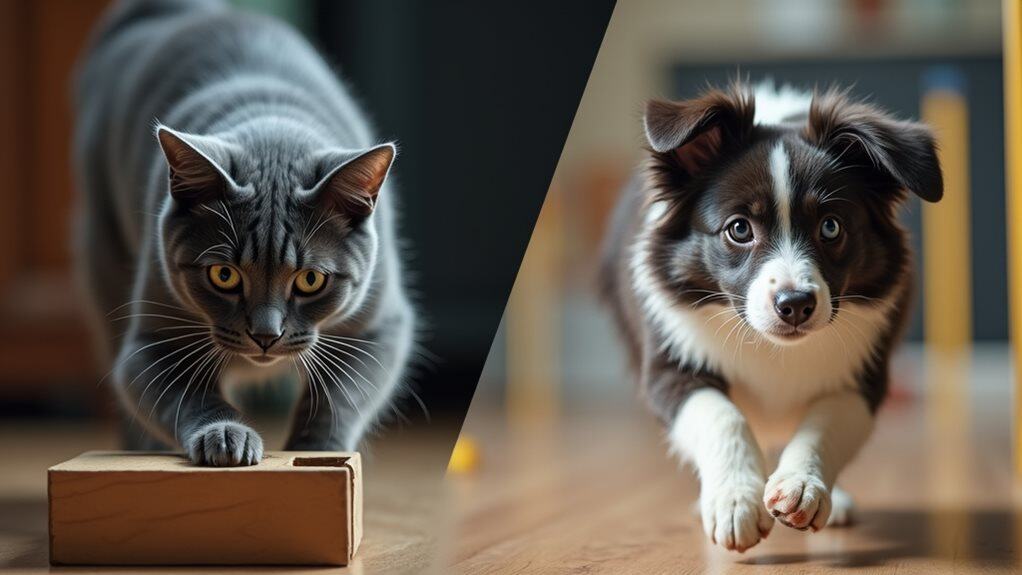
While dogs evolved alongside humans for over 30,000 years, cats took a different evolutionary path that’s shaped their distinct cognitive abilities. Your canine companion developed skills for cooperative hunting and reading human emotions, while your feline friend honed independent hunting prowess and territorial awareness.
This difference explains why your dog enthusiastically follows commands while your cat seems to evaluate your requests as optional!
These evolutionary adaptations have given cats remarkable cognitive flexibility in different ways than dogs. You’ll notice your cat excels at problem-solving when motivated (especially if treats are involved), whereas dogs typically look to you for solutions.
Don’t mistake your cat’s independence for lower intelligence—they’ve simply evolved to think differently. Their brains developed to master solo hunting, spatial navigation, and resource management rather than social cooperation. Environmental enrichment significantly enhances their cognitive development, showcasing their advanced problem-solving capabilities.
Each species adapted intelligence suited to their survival needs.
Measuring Intelligence: Why Traditional Tests Fail Cats
These evolutionary differences lead us to an important question: how do we accurately measure animal intelligence?
Measuring animal intelligence requires understanding evolutionary adaptations rather than applying human-centered cognitive standards.
When you see your cat ignoring commands while your dog fetches enthusiastically, you’re witnessing the limitations of traditional intelligence tests. Most animal cognition studies were designed with social, cooperative animals in mind—like dogs.
Cats, being independent hunters, show alternative intelligence that these tests simply miss. Your feline companion isn’t failing intelligence tests; the tests are failing to capture their unique cognitive abilities. They excel at problem-solving when motivated but see little value in performing tricks for human approval. This understanding aligns with the idea of bonding and emotional connection, which underscores the importance of recognizing a cat’s independent problem-solving skills.
To truly understand cat intelligence, we need approaches that align with their natural behaviors and motivations. Researchers are now developing cat-specific evaluations that measure spatial memory, observational learning, and independent problem-solving—areas where cats often outshine their canine counterparts.
Problem-Solving Abilities: How Cats Navigate Their World
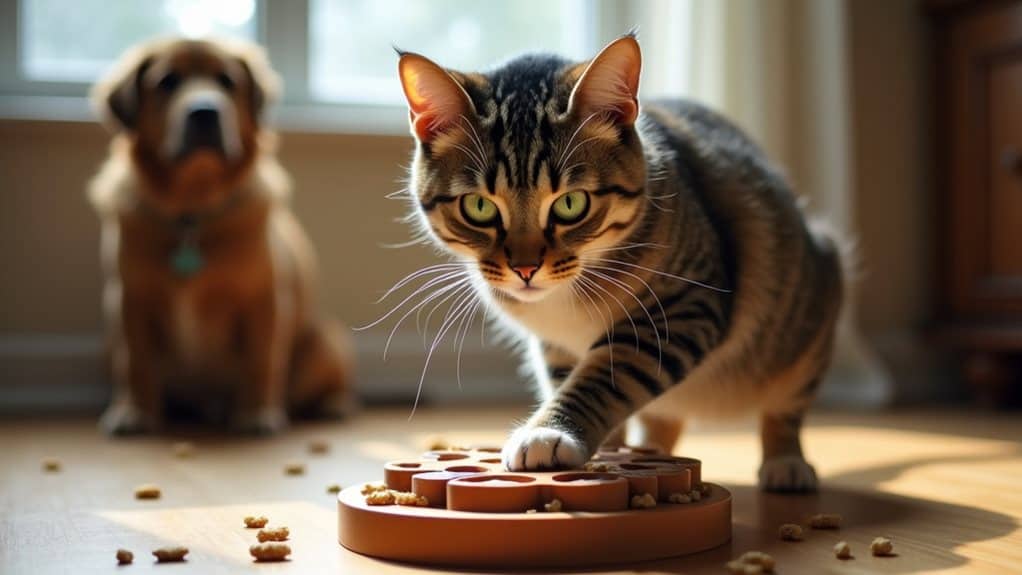
Despite their reputation for aloofness, cats demonstrate remarkable problem-solving skills when managing their environment. You’ll notice your feline friend’s spatial awareness when they maneuver through tight spaces or calculate jumping distances with precision. Their hunting strategies, whether stalking a toy mouse or waiting patiently by a mouse hole, reveal complex thinking patterns. Scratching behavior can also be an indicator of their intelligence, as it shows territorial marking and problem-solving in response to their environment.
| Skill | Cat Behavior | What It Shows |
|---|---|---|
| Persistence | Pawing under doors | Determination to access restricted areas |
| Adaptation | Finding new sleeping spots | Flexibility in changing environments |
| Memory | Remembering where treats are hidden | Long-term spatial memory |
| Innovation | Opening cabinets or doors | Mechanical problem-solving |
You’re witnessing intelligence in action when your cat figures out how to reach that high shelf or manipulates you into providing treats. Their problem-solving abilities might look different from dogs’, but they’re equally impressive!
Social Intelligence: Dogs’ Advantage or Different Feline Approach?
You’ll notice that while dogs form strong pack bonds and enthusiastically follow commands, cats take a more independent approach to social interactions.
Your canine companion might quickly learn to sit or fetch on command, whereas your feline friend operates more on their own terms, responding when they deem it worthwhile.
Both animals can recognize your emotions, but dogs typically show more obvious responses to your feelings, while cats display their awareness in subtler, easily missed ways.
Pack Bonding vs. Independence
When examining canine and feline social structures, we can’t ignore the fundamental differences in how they connect with humans and other animals.
Dogs, with their pack-oriented evolutionary history, naturally extend their bonding behaviors to include you as their leader or family member. Their social structures revolve around hierarchy and cooperation, making them enthusiastic to please and connect.
Cats, however, approach relationships differently. While they’re often labeled as aloof, they’ve simply retained their independent nature from ancestors who were solitary hunters. They form bonds on their terms, offering affection when they choose to.
This doesn’t mean they love you less—they just express it differently! Understanding these distinctions helps you appreciate why your dog follows you everywhere while your cat sometimes needs space. Both approaches have evolutionary advantages. Additionally, recognizing types of aggression in cats can enhance your ability to foster a harmonious environment between your pets.
Following Commands Comparison
Although both species demonstrate cognitive abilities, dogs and cats differ dramatically in how they respond to human commands. You’ll notice your dog enthusiastically waits for instructions, having evolved alongside humans as cooperative hunters and protectors. Command training with canines typically yields quick results, as they’re naturally inclined to please their human companions.
Your feline friend, however, approaches commands with a different mindset. Cats weren’t domesticated for obedience but rather for their independent hunting skills. The feline response to training isn’t necessarily a sign of lower intelligence—it’s just differently motivated. While you can teach cats commands, they’ll follow them when they see personal benefit, not simply to please you. This selective cooperation isn’t stubbornness but a reflection of their evolutionary history as solitary hunters who never needed to follow a leader.
Interestingly, studies show that cats experience oxytocin release during interactions with humans, further highlighting their unique ways of bonding.
Emotional Recognition Differences
Despite centuries of living alongside humans, dogs and cats process emotions in fundamentally different ways.
You’ve probably noticed how your dog seems to read your feelings instantly, wagging excitedly when you’re happy or nuzzling when you’re sad. This emotional expression is hardwired into canine behavior, making them natural empaths.
Your feline friend, however, demonstrates a subtler form of emotional intelligence. Cats aren’t oblivious to your feelings—they simply respond differently.
Feline empathy often manifests through quiet companionship rather than obvious displays. When you’re upset, your cat might sit closer than usual or purr softly beside you. They’re tuned into your emotional state but express their understanding on their own terms. Interestingly, cats may also express their care through behaviors such as hair-licking, which reflects their affection and strengthens the bond with their owners.
This doesn’t mean cats care less; they’re just communicating in their distinctly feline language that requires more careful observation to appreciate.
Memory and Observational Learning in Cats
Cats possess remarkable memory capabilities that you’ll notice if you’ve ever watched them traverse complex environments or return to a hidden toy months later. Their memory retention is surprisingly strong—they can remember people, places, and experiences for years, rather than days or weeks like you might expect.
You’ve probably seen your cat watching intently as you open a door or cabinet. That’s their observational strategies at work! Unlike dogs who often need direct training, cats learn primarily by watching.
They’ll study your movements, then practice when you’re not looking. This is why your cat suddenly knows how to open the treat drawer or turn on the faucet—they’ve been studying you all along!
Their ability to observe, remember, and apply knowledge makes them incredibly adaptable problem-solvers. Regular positive reinforcement techniques can further enhance their learning by creating positive associations during your interactions.
New Research Methods Revealing Hidden Feline Cognitive Strengths
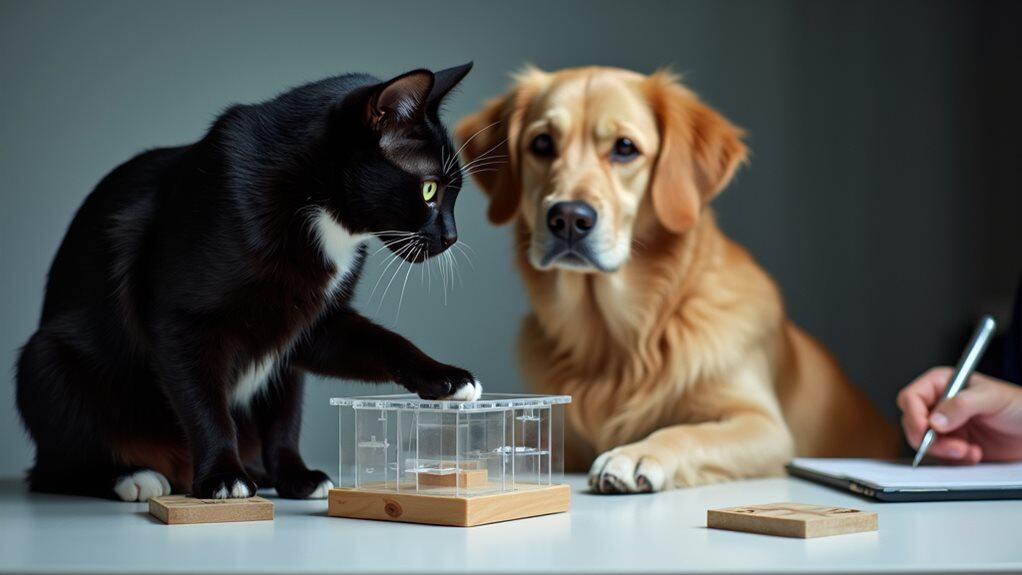
Until recently, traditional animal cognition tests overlooked many of feline intelligence’s most impressive aspects. Researchers now use methods that align with cats’ natural behaviors, revealing remarkable cognitive flexibility. You’ll find that cats excel at problem-solving when the setup matches their evolutionary adaptations—they’re not simply being stubborn!
| Research Approach | Traditional Methods | Cat-Friendly Methods |
|---|---|---|
| Test Environment | Laboratory setting | Home environment |
| Motivation | Food rewards only | Play and curiosity |
| Social Component | Human commands | Observational learning |
| Problem Solving | Dog-centric tasks | Environmental adaptation |
These new approaches show that your feline friend’s intelligence manifests differently than a dog’s. Rather than following commands, cats display intelligence through environmental adaptation—like figuring out complex puzzle feeders or remembering where prey might hide. Their cognitive flexibility lets them solve problems on their own terms, in their own time. Additionally, understanding feline behavior is crucial for enhancing the bond between cats and their owners, as it allows for better communication and interactions.
Frequently Asked Questions
Can Cats Understand Human Emotions Like Dogs Do?
Yes, you’ll notice cats recognize your emotions during human interaction, though they’re more subtle than dogs. They’ll respond to your mood through tail positions, purring, or giving you space when needed.
Do Indoor Cats Develop Different Intelligence Than Outdoor Cats?
Yes, they do. Your indoor cat develops different cognitive skills focused on home exploration and interactive play, while outdoor cats strengthen their hunting and survival instincts through varied environmental challenges. Both remain equally intelligent, just differently adapted.
At What Age Do Cats Reach Their Peak Cognitive Abilities?
Your cat’s cognitive development reaches its peak around 1-2 years of age. You’ll notice their problem-solving skills, memory, and social awareness plateau then, though they’ll continue learning throughout their life.
Can Cats Be Trained to Perform Complex Tasks Like Service Dogs?
You thought your feline overlord only excels at ignoring you? Yes, you can train cats to perform complex behaviors, though they’re typically less motivated than dogs. Cat training requires patience, consistency and meaningful rewards they actually care about.
Do Certain Cat Breeds Demonstrate Higher Intelligence Than Others?
Yes, breed comparisons show intelligence varies among cats. You’ll notice Abyssinians, Siamese, and Bengals often excel in intelligence measures like problem-solving and learning. They’re quicker to master puzzles and interactive toys than other breeds.
Final Thoughts
As you’ve traveled through the misty forest of animal cognition, you’ll see cats aren’t less intelligent than dogs—they’re differently brilliant. Like the moon to the sun, feline minds shine in their own distinct way. They’re observant shadows in your home, solving puzzles on their terms. Next time your cat watches you with those knowing eyes, remember: they’re not merely pets, they’re cerebral companions walking their own path of intelligence.