The Best Fluffy Pancakes recipe you will fall in love with. Full of tips and tricks to help you make the best pancakes.


Most kittens arrive home at 8 weeks old — and most new owners have no idea what’s actually supposed to happen next. The first year is a whirlwind of vaccinations, growth spurts, personality shifts, and a closing socialization window that nobody warns you about. This kitten care guide week by week breaks it all down so you know exactly what to expect, when to act, and when to relax.
Key Takeaways
- Kittens should weigh roughly 2 pounds at 8 weeks and gain about 1 pound per month through their first 6 months.
- The socialization window closes around 12–14 weeks — what happens during this period shapes your cat’s personality for life.
- Core vaccinations start at 8 weeks and follow a strict schedule through 16 weeks; missing boosters matters.
- Kittens can be spayed or neutered as early as 8 weeks if they weigh at least 2 pounds.
- Feed kitten-specific food (wet and dry) 3–4 times daily until 12 months, then transition to adult food.
- First-year kitten costs typically run $1,000–$2,000 USD, depending on vet costs, supplies, and food choices.
- Indoor kittens can safely experience limited outdoor time with a harness — but unsupervised outdoor access before 6 months is risky.
- Daily play sessions of 15–20 minutes (two or three times a day) are essential for healthy development.
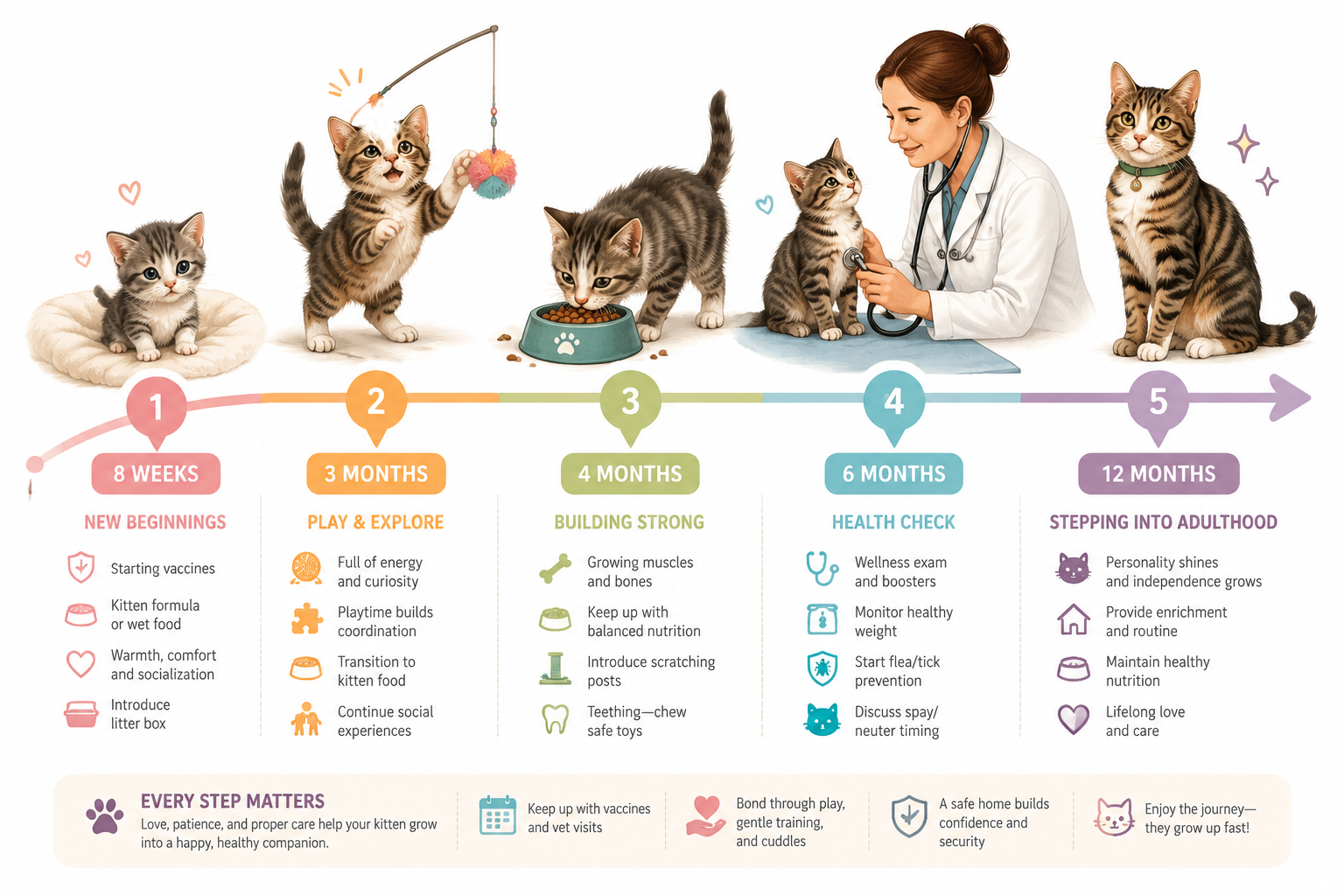
Your Kitten Care Guide Week by Week: The Big Picture Timeline
Here’s the honest answer: kitten development moves fast, and the milestones that matter most are front-loaded. The first 14 weeks are more formative than the rest of the year combined.
Use this table as your at-a-glance reference. Everything below expands on each stage.
| Age | Weight (approx.) | Key Milestone | Vet Action |
|---|---|---|---|
| 8 weeks | 1.9–2.1 lbs | All baby teeth present; adoption-ready | First FVRCP vaccine |
| 10–12 weeks | 2.5–3 lbs | Peak playfulness; socialization window closing | FVRCP booster; FeLV #1 |
| 14–16 weeks | 3.5–4 lbs | Adult eye color set; socialization window closed | FeLV #2; rabies vaccine |
| 4–5 months | 4–5 lbs | Teething; baby teeth falling out | Discuss spay/neuter timing |
| 6 months | 5–7 lbs | Sexual maturity approaching | Spay/neuter if not done |
| 9–12 months | 8–10 lbs | Physically adult; may still act kittenish | Annual booster planning |
What Do 8-Week-Old Kittens Actually Need to Eat?
At 8 weeks, kittens need kitten-specific food — not adult cat food — offered 3 to 4 times daily. Their tiny bodies are growing at a pace that requires much higher protein and calorie density than adult cats need.
Offer both wet and dry kitten food from the start. Wet food supports hydration and is easier on developing teeth; dry food helps with dental health and is calorie-dense. Fresh water should always be available — a stainless steel cat water fountain is a great investment because kittens are notoriously bad at drinking still water.
Avoid cow’s milk entirely. It causes digestive upset in most cats and has no nutritional benefit. For a deeper look at wet vs. dry options as your kitten grows, the wet vs. dry cat food nutrition guide covers everything you need to make a confident choice.
Feeding schedule by age:
- 8–12 weeks: 3–4 small meals per day
- 3–6 months: 3 meals per day
- 6–12 months: Transition to 2–3 meals; begin reducing to adult portions around 10–12 months
🐱 Kitten Milestone Tracker
Drag the slider to see what your kitten needs at each stage.
How Much Should a Kitten Weigh at Different Ages?
A healthy kitten gains roughly 1 pound per month for the first 6 months. At 8 weeks, expect around 2 pounds; by 6 months, most kittens reach 5–7 pounds; by 9–12 months, they’re typically at their adult weight of 8–10 pounds.
Weigh your kitten weekly at home using a kitchen scale. If weight gain stalls for more than two weeks, that’s worth a vet call. Rapid weight loss is always urgent.
Quick rule: If you can feel your kitten’s ribs easily but can’t see them, weight is likely on track. If ribs are visible or the belly looks bloated, speak to your vet.
When Can Kittens Get Their First Vaccinations?
The first vaccination is given at 8 weeks old — specifically the FVRCP vaccine, which covers feline herpesvirus, calicivirus, and panleukopenia (distemper). This is the core vaccine every kitten needs regardless of lifestyle.
Standard vaccination schedule:
- 8 weeks: FVRCP #1
- 12 weeks: FVRCP booster + FeLV (feline leukemia) #1
- 16 weeks: FeLV #2 + rabies vaccine
The FeLV vaccine is especially important for kittens who’ll have any outdoor access. Missing the 12-week booster isn’t just a minor inconvenience — it can leave your kitten unprotected during a critical window. For a full breakdown of what each vaccine does, the cat vaccination guide is worth bookmarking.
How Do I Know If My Kitten Is Developing Normally?
Normal kitten development follows a fairly predictable pattern. At 8 weeks, all baby teeth are in, coordination is solid, and the kitten should be curious and energetic. By 12 weeks, adult eye color is established and playfulness peaks. By 9 months, most kittens have reached adult size.
Signs development is on track:
- Steady weekly weight gain (about 3–4 oz per week in the first months)
- Bright, clear eyes with no discharge
- Clean ears with no dark debris
- Active interest in food and play
- Normal litter box habits (urinating multiple times daily, defecating once or twice)
When to call the vet: Lethargy that lasts more than a day, refusal to eat for more than 12 hours, diarrhea or vomiting more than twice in 24 hours, or any signs of labored breathing.
For a detailed breakdown of what to expect month by month, the cat development milestones guide is an excellent companion resource.
The Socialization Window: Why Weeks 8–14 Are Critical
This is the part most kitten guides skip, and it’s arguably the most important section in this entire kitten care guide week by week. The socialization window — the period when a kitten’s brain is most receptive to new experiences — closes around 12 to 14 weeks of age.
Whatever a kitten is exposed to during this window becomes “normal” to them for life. Kittens handled gently and regularly during weeks 8–14 tend to become confident, affectionate adult cats. Kittens who miss this window often grow into fearful or reactive adults, even with the best care afterward.
What to do during weeks 8–14:
- Handle paws, ears, and mouth daily (makes future grooming and vet visits easier)
- Introduce different sounds: vacuum cleaners, doorbells, children’s voices
- Let them meet calm, vaccinated dogs or other cats if possible
- Expose them to different textures and surfaces
- Invite different people to interact with them gently
The window doesn’t slam shut at week 14 — it just gets harder. Socialization still matters after this point, but the effort required increases significantly. If you’ve adopted a rescue cat who missed early socialization, the guide on building confidence in fearful cats has practical strategies.
Common Health Problems in Kittens During the First Months
Young kittens are resilient, but their immune systems are still developing. The most common issues in the first few months are upper respiratory infections, intestinal parasites, ear mites, and ringworm.
Most common kitten health issues:
- Upper respiratory infections (URI): Sneezing, runny nose, watery eyes. Very common in shelter kittens. Usually resolves with supportive care but can need antibiotics.
- Intestinal parasites (roundworms, giardia): Many kittens are born with roundworms. A fecal test at the first vet visit catches these early.
- Ear mites: Dark, coffee-ground-like debris in the ears. Treatable with drops from your vet. Our feline ear care guide shows what healthy ears should look like.
- Ringworm: Despite the name, it’s a fungal infection. Causes circular patches of hair loss and is contagious to humans.
- Fading kitten syndrome: Rare but serious — kittens under 8 weeks who fail to thrive. Less common at adoption age.
What Supplies Do I Absolutely Need for a New Kitten?
Before your kitten comes home, have the essentials ready. Running out to buy a litter box after the kitten arrives is a stressful experience nobody needs.

The non-negotiables:
- Shallow litter box with fine-grain, unscented litter
- Kitten-specific wet and dry food
- Stainless steel or ceramic food and water bowls
- A cozy kitten bed in a quiet corner
- Wand toys, crinkle balls, and a scratching post
- Carrier for vet visits
- Nail clippers (start trimming early so they get used to it)
Nice to have early on:
- A kitten harness if you plan any supervised outdoor time
- Puzzle feeders to slow eating and stimulate the brain
- A kitten toy set with variety — kittens get bored fast
One thing people often forget: cat-proof the home before the kitten arrives. Toxic houseplants are a surprisingly common hazard — the guide to cat-safe vs. toxic plants is worth a quick read before day one.
How Do I Litter Train a Young Kitten?
Most kittens at 8 weeks already know how to use a litter box — their mother taught them. The job is simply to make the box easy to find and appealing to use.
Place the litter box in a quiet, low-traffic area. Use fine-grain, unscented litter (heavily scented litters can put kittens off). Keep the box scooped at least once daily — kittens are fastidious and will avoid a dirty box.
If accidents happen: Gently place the kitten in the box after meals and after naps. Never punish accidents. Clean the spot thoroughly with an enzymatic cleaner so the scent doesn’t draw them back.
One common mistake: using a box with high sides for a tiny kitten. They physically can’t climb in. Start with a shallow tray or even a cut-down cardboard box lined with a bag.
Can Indoor Kittens Go Outside at All?
Yes — but supervised outdoor time is very different from unsupervised roaming. Indoor kittens can safely experience the outdoors with a harness and leash, a secure catio, or a fully enclosed garden.
Wait until the full vaccination course is complete (around 16 weeks) before any outdoor exposure. Before that, their immune systems aren’t fully protected. When you do start, keep sessions short and calm — a panicked first experience can make a kitten permanently reluctant.
Unsupervised outdoor access before 6 months carries real risks: traffic, predators, disease from unvaccinated cats, and getting lost. Many experienced cat owners choose to keep their cats fully indoor and enrich the environment instead — vertical space, window perches, and puzzle feeders go a long way.
How Much Playtime Does a Kitten Really Need Each Day?
Kittens need at least 30–45 minutes of active play daily, split into two or three sessions. This isn’t optional — it’s how they develop coordination, burn energy, and learn appropriate behavior.
Between 3 and 6 months, energy levels peak. A kitten that doesn’t get enough play will find its own entertainment, usually at 3am on your face. Interactive wand toys are the gold standard because they mimic prey movement and keep you involved.
Critical rule: Never use your hands as toys. It teaches kittens that biting and scratching humans is acceptable play, and that habit is very hard to break in an adult cat.
As kittens move into adolescence (6–12 months), play sessions can get slightly longer and more complex. Indoor scavenger hunts and puzzle feeders are excellent for keeping an adolescent cat mentally stimulated without wearing you out.
Male vs. Female Kitten Care: Are There Real Differences?
For the first few months, male and female kittens need essentially identical care. The differences emerge around 4–6 months when hormones kick in — and they’re significant if spaying or neutering is delayed.
Unneutered males begin scent-marking (spraying) and may become aggressive or escape-focused. Unspayed females go into heat cycles that are loud, stressful for the cat, and frequent. Spaying or neutering before 6 months prevents most of these issues entirely.
After the procedure, behavioral differences between males and females are mostly subtle and individual. Some owners report males being more affectionate; others swear females are. Personality varies far more by individual cat than by sex. For everything you need to know about timing and recovery, the spaying and neutering guide covers it thoroughly.
Are Some Cat Breeds Easier to Raise Than Others?
Some breeds are genuinely more forgiving for first-time owners. Ragdolls, British Shorthairs, and Scottish Folds tend to be calmer and more adaptable. Bengals, Abyssinians, and Siamese are highly intelligent and active — wonderful cats, but they need more stimulation and engagement.
That said, individual personality matters more than breed in most cases. A well-socialized mixed-breed kitten from a good rescue can be just as easy (or easier) to raise as a pedigree kitten. The socialization window coverage above applies equally to all breeds.
Choose a calmer breed if: You work long hours, live in a small space, or are a first-time cat owner.
Choose a higher-energy breed if: You want an interactive, engaged companion and can commit to daily enrichment.
What’s the Average Cost of Kitten Care in the First Year?
The honest estimate for first-year kitten costs in the US is $1,000–$2,000, and it can go higher depending on your location and choices. This catches many new owners off guard.
Rough cost breakdown:
- Adoption fee or purchase: $50–$1,500+
- Initial vet visit + vaccinations: $150–$300
- Spay/neuter: $200–$500
- Supplies (litter box, bed, toys, carrier): $150–$300
- Food (first year): $300–$600
- Unexpected illness or injury: highly variable
Pet insurance is worth serious consideration in year one, when kittens are most likely to get into trouble. The cat insurance guide breaks down what coverage actually makes sense for kittens vs. adult cats.
Signs a Kitten May Have Been Weaned Too Early
Kittens weaned before 6–7 weeks often show specific behavioral patterns that persist into adulthood. The most common sign is wool-sucking or fabric-sucking — a self-soothing behavior that mimics nursing. Early-weaned kittens may also be more anxious, more prone to aggression during play, or have trouble with social boundaries.
Physically, they may struggle with solid food at first and have more digestive upsets. If you’ve adopted a kitten and notice excessive suckling on blankets, fingers, or other cats, early weaning is a likely explanation — not a character flaw.
These kittens can absolutely thrive with patient, consistent care. Extra gentle handling during the socialization window and appropriate play boundaries make a real difference.
FAQ
How often should I take my kitten to the vet in the first year?
Plan for at least four vet visits in year one: the initial wellness check when you bring them home, then follow-up appointments at 12 weeks, 16 weeks, and 6 months (for spay/neuter or a wellness check). More visits may be needed if health issues come up.
Can I give my kitten human food as a treat?
Small amounts of plain cooked chicken or fish are generally safe as occasional treats. Avoid onions, garlic, grapes, raisins, chocolate, and anything with xylitol — these are toxic to cats. For safer options, check out kitten-appropriate snacks.
My kitten is biting hard during play. Is this normal?
Yes, but it needs redirecting immediately. Stop play the moment teeth or claws make contact with skin. Offer a toy instead. Consistency is everything — if one person in the household allows rough play, the kitten won’t understand why others don’t.
When should I switch from kitten food to adult cat food?
Around 12 months for most breeds. Large breeds like Maine Coons may benefit from staying on kitten food until 18 months. The age-specific cat feeding guide covers the transition in detail.
What are signs a kitten might be weaned too early?
Watch for wool-sucking or fabric-sucking behavior, excessive anxiety, difficulty eating solid food, and poor social boundaries with other cats. These behaviors are manageable with patience but rarely disappear entirely.
Is it okay to get a second kitten at the same time?
Getting two kittens together is often easier than introducing a second cat later. Littermates or same-age kittens socialize each other, burn energy through play, and are less likely to develop boredom-related behavior problems. The guide to introducing a new cat is helpful if you’re adding a second cat to a home that already has one.
Conclusion
The first year with a kitten is genuinely one of the most rewarding experiences in cat ownership — and also one of the most information-dense. This kitten care guide week by week is designed to take the guesswork out of it.
Your action plan:
- Book a vet appointment within 48 hours of bringing your kitten home.
- Start gentle socialization immediately — you have a narrow window.
- Follow the vaccination schedule without gaps.
- Get spay/neuter on the calendar before 6 months.
- Play with your kitten every single day — it shapes their personality as much as anything else.
The kitten who gets consistent care, early socialization, and a stimulating environment in that first year becomes the confident, affectionate adult cat you’ll share your life with for the next decade or more. It’s worth every effort.
For a deeper dive into the full first year, the complete kitten care guide at Feline Fascination has everything in one place.