The Best Fluffy Pancakes recipe you will fall in love with. Full of tips and tricks to help you make the best pancakes.

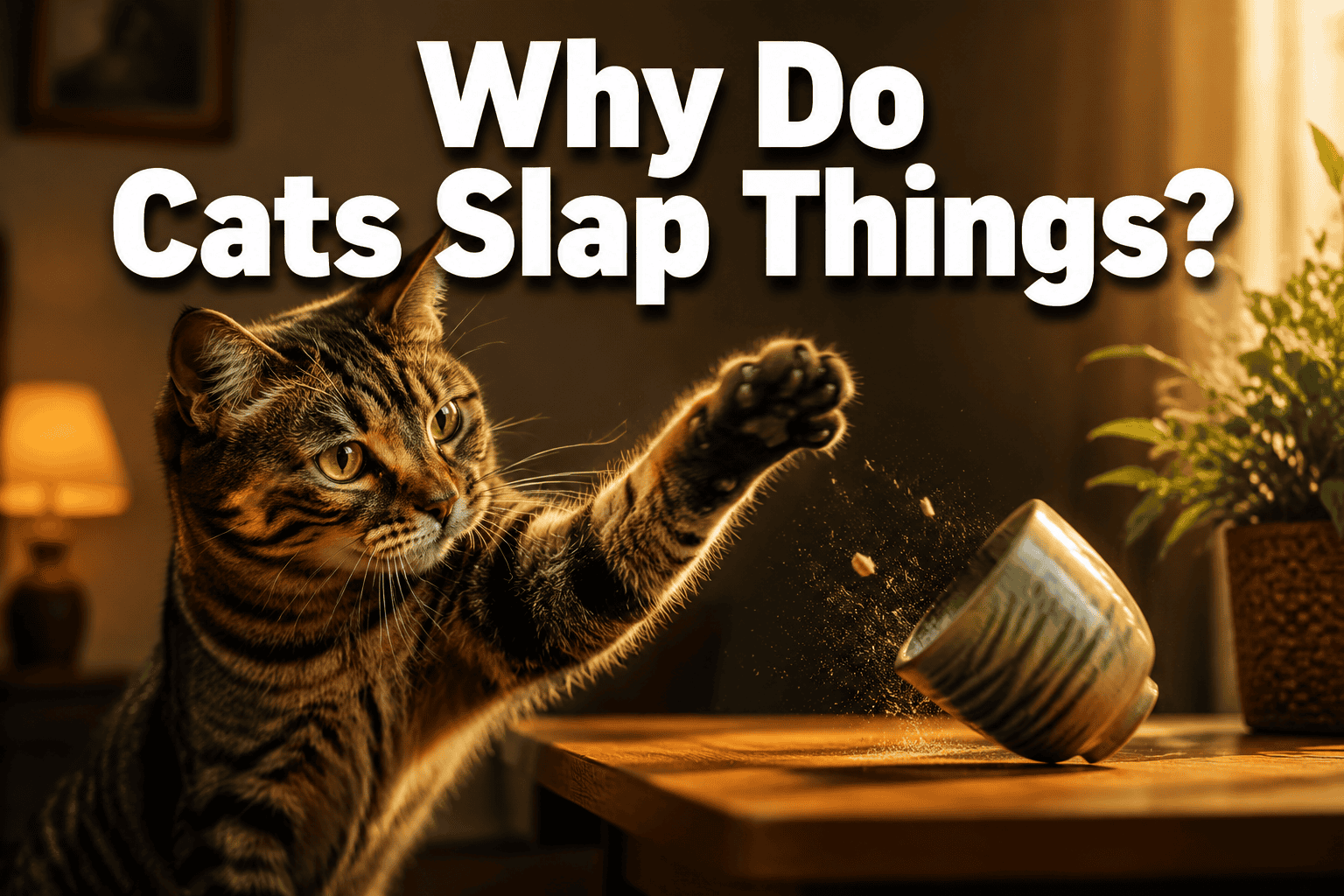
Quick Answer: Cats slap things because it’s hardwired into them — it’s a mix of hunting instinct, curiosity, attention-seeking, and sometimes a very clear “back off” signal. The behaviour is almost always normal, but the context tells you exactly what your cat is trying to communicate.
Key Takeaways
- Cats slap objects to investigate them safely before getting closer — it’s a built-in survival tool
- Knocking things off tables is often deliberate attention-seeking or play, not random chaos
- Slapping at people can mean playfulness, overstimulation, or a genuine warning — body language tells you which
- Some breeds (especially high-energy and intelligent ones) slap things more than others
- Boredom is one of the most common triggers for excessive slapping in indoor cats
- A sudden increase in slapping or swatting can occasionally signal stress, anxiety, or a health issue
- You can reduce unwanted slapping with enrichment, clear boundaries, and a few simple environmental changes
- Kittens slap more frequently than adult cats as part of learning — it usually settles down with age
Why Do Cats Slap Things Off Tables?
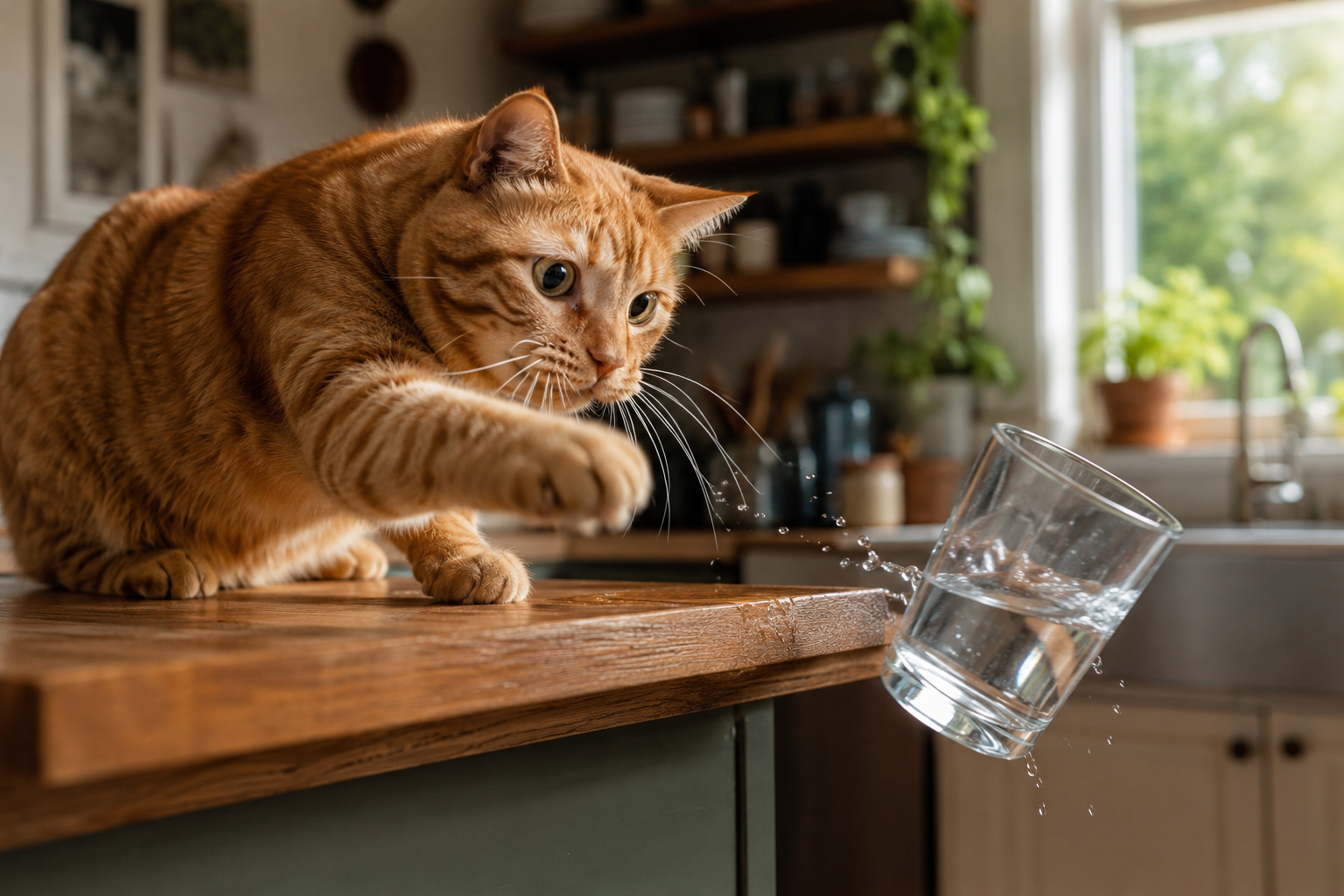
Cats knock things off tables on purpose — and they usually know exactly what they’re doing. The behaviour comes down to two things: curiosity and a deeply ingrained hunting instinct. Before a cat commits to investigating something with its nose or mouth, a quick paw-swipe tells it whether the object is alive, safe, or worth pursuing.
A cat’s paw pads are packed with sensitive nerve endings. That single slap gives them a huge amount of tactile information — texture, temperature, whether it moves. It’s the feline equivalent of picking something up and turning it over in your hands.
The “knocking things off tables” version of this behaviour has an added layer: attention. If your cat has learned that sending your phone skidding across the counter gets you out of your chair immediately, congratulations — you’ve trained your cat to do exactly that. Cats are far more strategic than we give them credit for. (For more on just how clever they really are, see our piece on feline intelligence and how smart cats are compared to dogs.)
Common mistake: Reacting dramatically every time your cat knocks something over actually reinforces the behaviour. Even negative attention is still attention.
🐾 What’s Behind Your Cat’s Slapping?
Answer 3 quick questions to find out.
1. When does your cat slap most?
2. What does your cat’s body look like?
✅ Playful slapping — totally normal! Redirect to wand toys and schedule daily play sessions to keep it fun and safe.
⚠️ Warning slap — your cat is overstimulated or stressed. Give them space, check for pain triggers, and avoid forcing interaction.
💡 Boredom/attention-seeking — your cat needs more enrichment. Try puzzle feeders, rotating toys, and two play sessions per day.
Is Cat Slapping a Sign of Aggression or Playfulness?
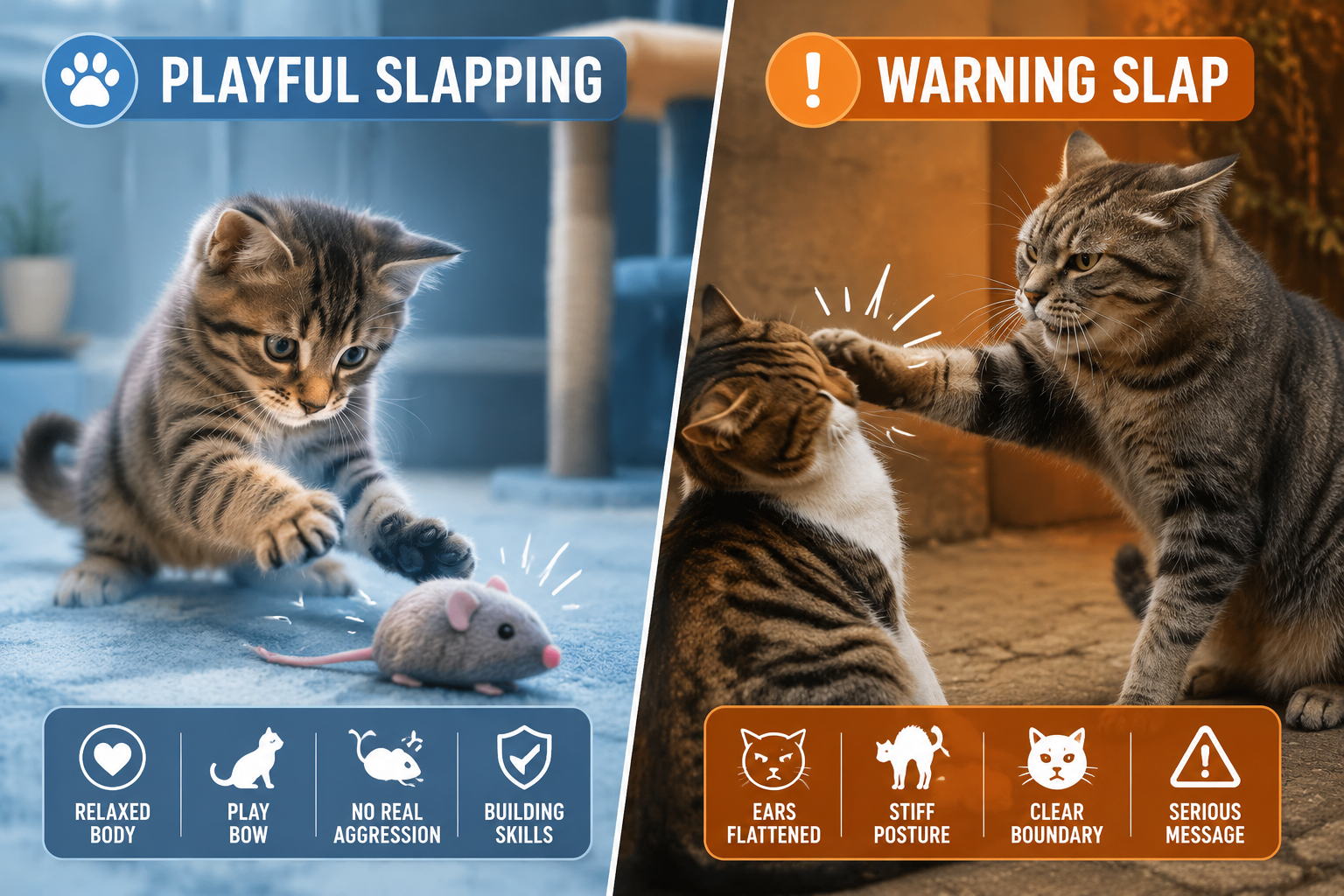
Most of the time, cat slapping is playful — but body language is everything. A relaxed cat with soft eyes and an upright tail who bats at your hand is playing. A cat with flattened ears, a puffed tail, dilated pupils, and a stiff body who swipes at you is issuing a warning.
How to tell the difference at a glance:
| Signal | Playful Slap | Warning Slap |
|---|---|---|
| Ears | Forward or neutral | Flat or rotated back |
| Eyes | Soft, normal pupils | Wide, dilated pupils |
| Tail | Upright or gently swishing | Puffed, lashing, or low |
| Claws | Often retracted | Usually extended |
| Vocalisation | Silent or chirping | Hissing, growling |
| Body posture | Loose and bouncy | Stiff, crouched, or raised |
If you’re seeing warning slaps regularly, it’s worth reading our cat behaviour decoded guide to understand what else your cat’s body is telling you.
Choose playful enrichment if: your cat slaps during interactive play sessions and shows relaxed body language throughout. Seek advice if: slapping comes with growling, hissing, or is directed at people unpredictably.
Do Cats Slap Things When They’re Bored or Want Attention?
Yes — and this is one of the most common reasons why do cats slap things gets searched so often. An under-stimulated indoor cat will create its own entertainment, and that usually involves your belongings.
Boredom slapping tends to happen at predictable times: early morning, late evening, or whenever you sit down to do something that doesn’t involve the cat. If your cat has learned that batting your coffee mug gets a reaction, boredom and attention-seeking have merged into one very effective strategy.
The fix is straightforward: more enrichment before the chaos starts. Puzzle feeders, rotating toys, and dedicated play sessions go a long way. Our guides on preventing cat boredom with activities for indoor cats and mental stimulation games and puzzles for intelligent cats have plenty of practical ideas that actually work.
What Breed of Cats Slap Things the Most?
High-energy, intelligent, and prey-drive-heavy breeds tend to be the biggest slappers. It’s not that other cats don’t do it — they do — but certain breeds are wired to interact with their environment more intensely.
Breeds known for frequent slapping and batting behaviour include:
- Bengal — extremely high prey drive, very paw-oriented
- Maine Coon — playful and curious well into adulthood
- Siamese — attention-seeking and vocal, uses slapping to communicate
- Abyssinian — constantly active, investigates everything
- Scottish Fold — surprisingly playful despite the calm appearance
- Turkish Van — nicknamed “the swimming cat,” also loves batting objects
That said, individual personality matters as much as breed. A rescue cat with a bold, curious temperament will out-slap a laid-back Bengal any day. If you have a high-energy breed, vertical space and cat-friendly home design can channel that energy productively.
What Does It Mean When a Cat Slaps Another Cat?
When cats slap each other, it usually means one of three things: play, a boundary being set, or a dominance signal. Context and the response of the cat being slapped tells you which one it is.
Playful slapping between cats looks loose and reciprocal — both cats take turns, nobody hisses, and they stay close together afterwards. A boundary slap is a single firm swipe that says “I’ve had enough of you” — the slapper then walks away. A dominance or stress-related slap tends to be more forceful, often aimed at the head or neck, and may escalate if the other cat doesn’t back down.
Edge case: In multi-cat households, frequent one-sided slapping where one cat is consistently the target can signal a genuine social tension problem, not just play. If the slapped cat is hiding, not eating, or showing signs of anxiety, it’s worth addressing the household dynamics. Our article on fearful and anxious cats covers how to help a cat who’s on the receiving end.
Is Cat Slapping Normal Behaviour or a Medical Issue?
In the vast majority of cases, slapping is completely normal cat behaviour — it’s part of how cats play, hunt, communicate, and explore. There’s no cause for concern if your cat has always done it and nothing else has changed.
However, a sudden increase in slapping or swatting — especially if directed at people who weren’t previously targets — can occasionally point to an underlying issue. Pain is a common one. A cat who is hurting (from arthritis, dental pain, or an injury) may lash out when touched in a way that previously caused no reaction.
Signs that slapping might warrant a vet check:
- It’s new behaviour with no obvious trigger
- The cat flinches or vocalises when touched before slapping
- It’s accompanied by changes in appetite, litter box habits, or grooming
- The cat is over 10 years old (pain-related aggression is more common in seniors — see our senior cat care guide)
Can Cat Slapping Be a Sign of Stress or Anxiety?
Yes. A stressed or anxious cat is more reactive, and that often shows up as increased swatting. If something in the environment has changed — a new pet, a house move, a new baby, a change in routine — slapping can be one of the first behavioural signals that your cat isn’t coping well.
Stress-related slapping usually comes with other signs: hiding more, over-grooming, changes in appetite, or spraying. The slapping itself is rarely the whole picture.
If you suspect stress is the driver, start by identifying what changed. Then look at ways to restore predictability and safe space for your cat. Calming music, consistent routines, and pheromone diffusers can all help. Our piece on calming music for cats is a good starting point.
Do Kittens Slap Things Differently Than Adult Cats?
Kittens slap everything — and they do it more frequently, more enthusiastically, and with considerably less accuracy than adult cats. This is completely normal. Slapping and batting are how kittens develop coordination, learn about their environment, and practise the hunting skills they’d need in the wild.
Kitten slapping is almost always play-driven. Their claws are sharp but their swipes are uncontrolled, which is why kitten scratches often look worse than adult cat scratches despite being less intentional.
By around 12–18 months, most cats settle into a more measured version of the behaviour. High-energy breeds may stay in “kitten mode” for longer — sometimes up to three years. If your kitten’s slapping is drawing blood during play, redirect immediately to a toy rather than your hands. Teaching bite and scratch inhibition early saves a lot of trouble later.
How Much Damage Can Cat Slapping Cause to Household Items?
Honestly? Quite a bit, if your cat has good aim and a taste for expensive things. Glasses, mugs, and small electronics are the most common casualties. A single well-placed swipe can send a full water glass onto a laptop keyboard.
The damage risk goes up with:
- Surface height — the higher the shelf, the harder the fall
- Object weight — lighter objects travel further
- Cat size and strength — larger breeds hit harder
- Frequency — a cat who does this 20 times a day will eventually break something
What should you do if your cat keeps targeting expensive items? Move them. It sounds obvious, but the fastest solution is to remove the temptation entirely. Keep phones, glasses, and anything fragile off surfaces your cat patrols. Use museum putty or non-slip mats for items that need to stay out. And give your cat something more interesting to interact with — a puzzle feeder on the counter beats your mug every time.
How to Stop Cats From Slapping and Knocking Things Over
The good news: this behaviour is very manageable once you understand what’s driving it. There’s no single fix, but a combination of enrichment, redirection, and environmental changes works well for most cats.
Step-by-step approach:
- Identify the trigger. Is it boredom, attention-seeking, play, or stress? The solution depends on the cause.
- Increase interactive play. Two 10–15 minute wand toy sessions per day dramatically reduce attention-seeking slapping for most cats.
- Provide more environmental enrichment. Sensory enrichment for indoor cats gives your cat legitimate outlets for that curious, paw-happy energy.
- Don’t reward the behaviour. If your cat knocks something over and you immediately give attention, you’ve reinforced it. Ignore the behaviour where safe to do so.
- Protect high-risk items. Move fragile objects, use non-slip surfaces, and keep valuables in closed rooms or drawers.
- Redirect, don’t punish. Punishment doesn’t work well with cats and damages trust. Redirect to a toy the moment slapping starts.
- Check for stress triggers. If the behaviour is new or escalating, look for environmental changes and address them.
Cat owner tip: A cat who gets a solid play session 30 minutes before your most productive work hours is a much calmer cat. Timing enrichment strategically makes a real difference for indoor cat owners working from home.
FAQ
Why does my cat slap me in the face while I’m sleeping?
This is almost always attention-seeking or a request for food. Cats learn quickly that a paw to the face gets results. The best fix is to not reward it — easier said than done at 5am, but consistency matters.
Is it okay to let my cat slap my hands during play?
Short-term, yes. Long-term, it teaches your cat that hands are toys, which leads to harder biting and scratching as they get older. Always redirect to a wand toy or feather instead.
Why do cats slap things and then look at you?
That look is deliberate. Your cat is checking whether the slap got your attention. It’s a communication strategy, and it works remarkably well on most cat owners.
My cat slaps the water bowl before drinking — is that normal?
Yes, completely normal. Cats often test still water with their paw before drinking because moving water signals freshness in the wild. A cat water fountain can reduce this behaviour significantly.
Why does my cat slap the food bowl?
Usually frustration or anticipation — especially if you’re late with a meal. Some cats also do it to move food around, as they prefer to eat from the centre of the bowl. Check out our thoughts on whisker fatigue as a possible factor too.
At what age do cats stop slapping things so much?
Most cats mellow out between 2–4 years old. High-energy breeds may stay active and slap-happy longer. Senior cats generally slap less, though any sudden decrease in activity in an older cat is worth mentioning to a vet.
Conclusion
So, why do cats slap things? Because they’re curious, playful, communicative, and occasionally a little manipulative — in the most endearing way possible. The behaviour is almost always normal and rooted in instinct, whether your cat is batting a pen off the desk, swatting at a passing ankle, or delivering a firm warning to the other cat in the house.
The key is reading the context. A relaxed swipe during play is very different from a stiff-bodied swat with flattened ears. Once you can tell those apart, you’ll know when to laugh it off, when to redirect, and when to take it seriously.
Your next steps:
- Watch your cat’s body language during the next slapping episode and match it to the table above
- If boredom or attention-seeking is the driver, add one dedicated play session per day this week
- Move any fragile or expensive items off surfaces your cat regularly patrols
- If the behaviour is new, sudden, or accompanied by other changes, book a vet check — it’s always worth ruling out pain or stress
Understanding your cat’s behaviour is one of the most rewarding parts of cat ownership. The more you tune in, the better your relationship gets.